

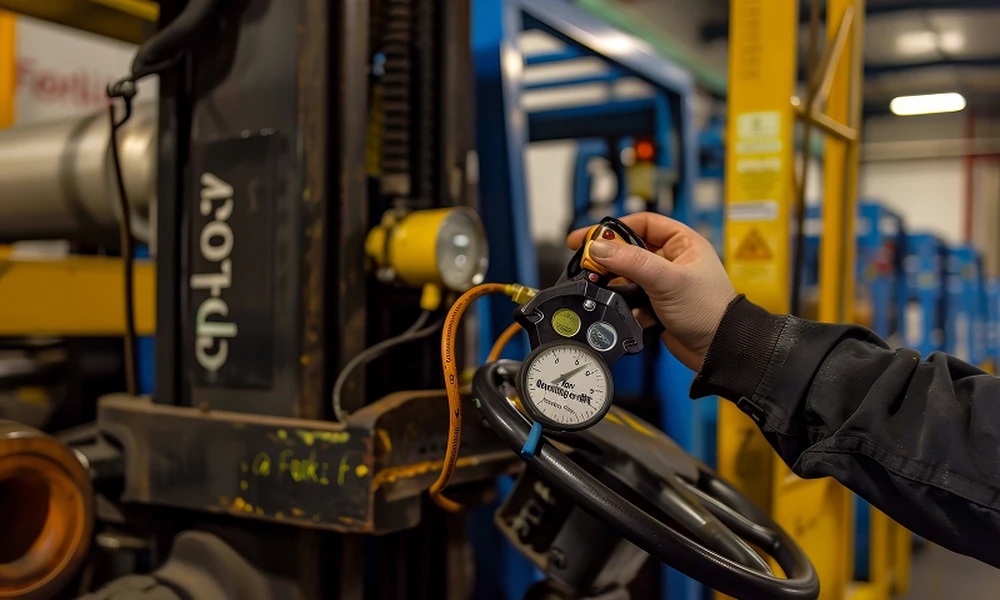
Image Recommendation: Close-up of a technician inspecting a forklift’s mast and hydraulic cylinder during a pre-purchase evaluation, hour meter visible on the dashboard.
Picture standing in front of two used forklifts with nearly identical hour meters, roughly the same age, and a similar asking price. On paper, they look like equivalent purchases. Walk around either one with a proper inspection checklist, and that similarity can disappear fast, because the meter only counts hours. It says nothing about how those hours were spent.
Why Hours Alone Are a Misleading Shortcut
A forklift that ran 4,000 hours on light, intermittent pallet work inside a climate-controlled warehouse has had a very different working life than one that ran the same 4,000 hours on heavy, continuous loads in an outdoor yard. The number on the meter treats both equally. A proper physical inspection is what actually reveals the difference.
What a Proper Inspection Should Cover
| Area | What to check |
| Mast and forks | Even wear, no visible bending, smooth lift and tilt through the full range of motion |
| Hydraulics | No fluid leaks around cylinders or hoses, consistent lift speed under load |
| Tyres or tracks | Even wear pattern across both sides, which can reveal alignment or load-distribution issues |
| Battery or engine | Battery cell condition and charge retention, or engine for unusual noise, smoke, or fluid residue |
Why the Mast and Hydraulics Deserve the Most Attention
Among everything on that checklist, the mast and hydraulic system tend to be where heavy, inconsistent past use shows up most clearly, and where repairs are also the most expensive. A truck shortlisted from a used forklift for sale listing is worth a hands-on check of both before any price negotiation goes further, ideally with the mast cycled through its full range under a representative load rather than just visually inspected while stationary.
What to Ask the Seller Directly
- What kind of environment and load type was this truck typically used in, not just how many hours it logged.
- Is there a maintenance record available, or is the service history undocumented.
- Has any major component, mast, transmission, hydraulic pump, already been replaced or rebuilt.
What a Clean-Looking Exterior Can Hide
A truck that’s been repainted or detailed before being listed can look considerably newer than its actual working condition reflects. That’s not necessarily a sign of dishonesty on the seller’s part; cosmetic touch-ups are a normal part of preparing equipment for resale, but it does mean exterior appearance should carry very little weight in an inspection compared with the mechanical checks that matter more: mast movement, hydraulic response, and tyre or track wear.
Where a Documented Parts History Becomes Useful Again
A seller connected to an established forklift parts supplier network is often in a better position to answer those maintenance questions accurately, since past parts and service records are more likely to exist and be retrievable, compared with a private sale or a reseller with no ongoing relationship to the truck’s service history.
A Simple Rule Worth Applying Before Any Purchase
Treat the hour meter as a starting filter, not a final answer. It’s useful for narrowing a shortlist down to a reasonable age range, but the inspection, and the seller’s ability to speak honestly about how a specific unit was actually used, is what should decide between two trucks that look similar on paper.
What Happens When This Step Gets Skipped
Skipping a proper inspection in favour of trusting the hour meter alone tends to surface its cost within the first year of ownership, usually as an unexpected hydraulic or mast repair on a truck that looked fine from a distance. That repair bill, combined with the downtime it causes, is almost always larger than the modest time cost of a proper inspection would have been upfront.
Why a Test Run Should Be Part of the Inspection, Not Optional
A static walk-around catches obvious wear, but some issues only show up once the truck is actually moving under load: a slight drift in steering, a hesitation when lifting at full height, a hydraulic system that performs differently once warmed up versus at a cold start. Wherever possible, a short operational test under conditions similar to the truck’s intended use is worth insisting on before finalising any used-equipment purchase, rather than relying on a stationary inspection alone.
Two forklifts with the same number on the dashboard can have led very different working lives. The meter is a starting point for comparison, not a substitute for actually looking the truck over.
Arranging a proper inspection before committing to a specific unit is easier with a direct conversation first. Contact Hyster-Yale Lift Trucks Singapore to arrange a viewing.